

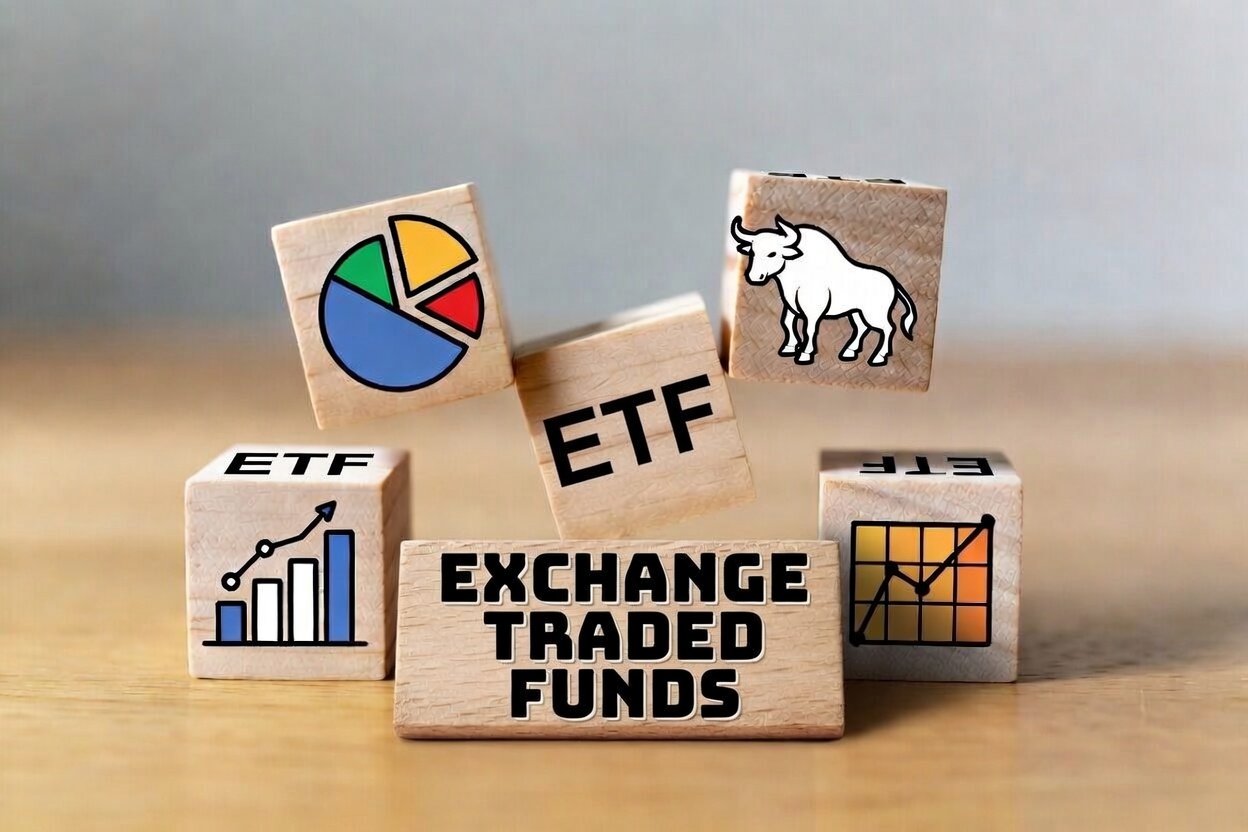
ETFs 101: Trading, Types, and Investing Strategies
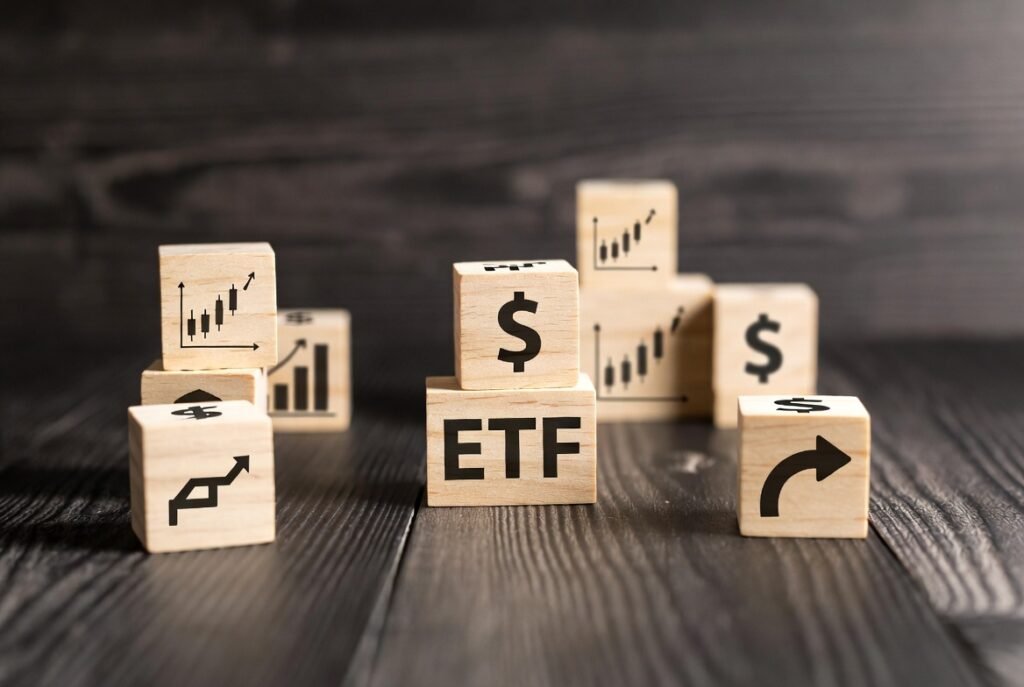
If you’re new to investing, you’ve probably heard the term ETF before. ETFs have quickly become one of the most popular ways for beginner investors to start building a portfolio. They allow you to invest in many companies at once, giving you instant diversification without needing to pick individual stocks.
Investing in an ETF can provide a simple and effective way to gain exposure to various markets.
In fact, many financial experts recommend including an ETF in your investment strategy to enhance your portfolio’s performance.
Incorporating an ETF into your investment strategy is essential for achieving diverse exposure.
ETFs, or Exchange-Traded Funds, are designed to track the performance of specific indices, making them an efficient choice for many investors.
This makes ETFs a great option for anyone looking to diversify their investments.
Understanding the basics of an ETF is crucial for any investor. Investing in an ETF is a straightforward approach that offers various benefits for new investors. Understanding the advantages of an ETF can help you make informed investment decisions.
In this guide, we’ll cover ETFs 101, including trading basics, types of ETFs, and simple strategies so you can start investing with confidence. By the end, you’ll understand why ETFs are a smart choice
Key Points
| Key Points about ETFs |
|---|
| 📌 ETFs (Exchange-Traded Funds) are investment funds that hold multiple assets, like stocks, bonds, or commodities. 📌 Beginner-friendly: ETFs allow you to invest in many companies at once, making it easier to diversify. 📌 Trade like a stock: You can buy and sell ETFs on the Toronto Stock Exchange (TSX) or U.S. exchanges throughout the day. 📌 Types of ETFs: Index ETFs, Sector ETFs, Bond ETFs, and International ETFs. 📌 Benefits: Lower fees, diversification, simplicity, and long-term growth potential. 📌 Common mistakes: Overtrading, chasing performance, investing in only one sector, or ignoring fees. 📌 Getting started: Open a brokerage account, deposit funds, choose beginner-friendly ETFs, and invest consistently. |
Choosing the right ETF can help you achieve your investment goals while minimizing risk.
The truth is, ETFs are one of the simplest ways to begin investing. Instead of choosing individual stocks one by one, ETFs allow you to invest in many companies at the same time. This makes them easier to manage and often less risky for beginners.
With an ETF, you can experience the benefits of a diversified portfolio without managing numerous individual investments.
By incorporating ETFs into your portfolio, you can manage risk while maximizing returns.
Investing in an ETF can be a wise choice for those looking to build a well-rounded portfolio.
What Is an ETF?
An ETF (Exchange-Traded Fund) is a type of investment fund that holds a collection of assets such as stocks, bonds, or commodities. Instead of buying one stock, an ETF allows you to invest in many different companies at once.

Think of it like this:
Buying a single stock is like buying one fruit at the grocery store.
Buying an ETF is like buying a fruit basket that contains many different fruits.
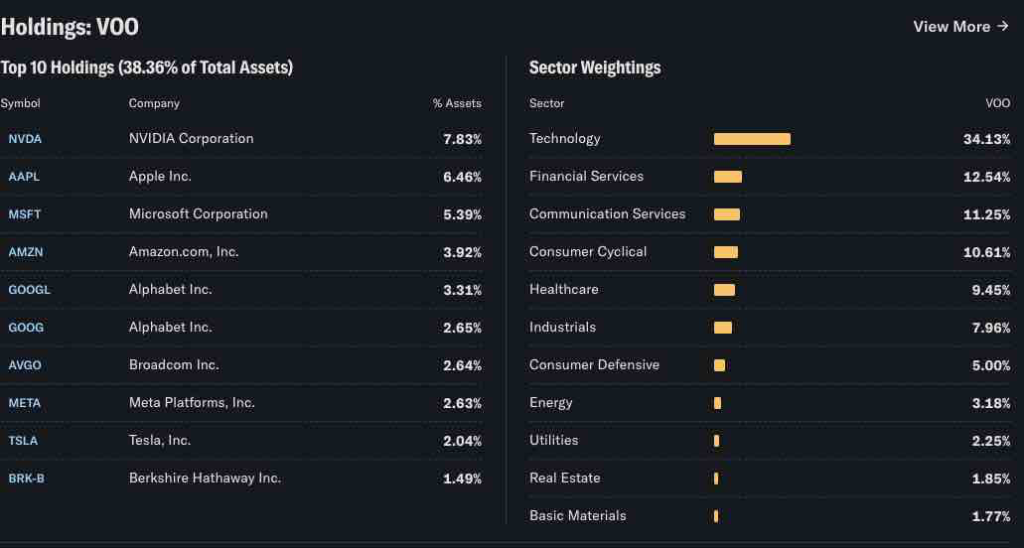
This built-in variety is called diversification, and it’s one of the biggest reasons ETFs are so popular with beginner investors. Many ETFs track a stock market index, such as the Vanguard S&P 500 ETF (VOO), which represents many of the largest companies in the U.S.
How ETFs Work
Many investors find that an ETF offers a convenient way to access global markets.
ETFs trade on stock exchanges just like individual stocks. You can buy and sell ETF shares during the trading day, making them very flexible.
For example, if you buy an ETF that tracks the TSX 60 Index, you are essentially investing in 60 of the largest companies listed on the Toronto Stock Exchange.
Key points to remember:
📌 ETFs trade like stocks: : Buy and sell during market hours
📌 Diversified: They contain multiple investments
📌 Index tracking: Most ETFs track a market index to match overall performance
Because of their diversification, ETFs are often less risky than investing in a single stock. Investors should consider how different ETFs fit into their overall strategy.
ETFs vs Stocks
One common question beginners ask is:
Should I buy individual stocks or ETFs?
Both options have benefits, but many beginners start with ETFs because they provide instant diversification.
| Feature | Stocks | ETFs |
|---|---|---|
| Ownership | One company | Many companies |
| Risk | Higher | Lower |
| Management | Self-managed | Fund tracks index |
| Best for | Experienced | Beginners |
With an ETF, you can take advantage of market trends without excessive risk. For someone just starting their investing journey, ETFs can provide a simple and balanced way to enter the market.
Types of ETFs
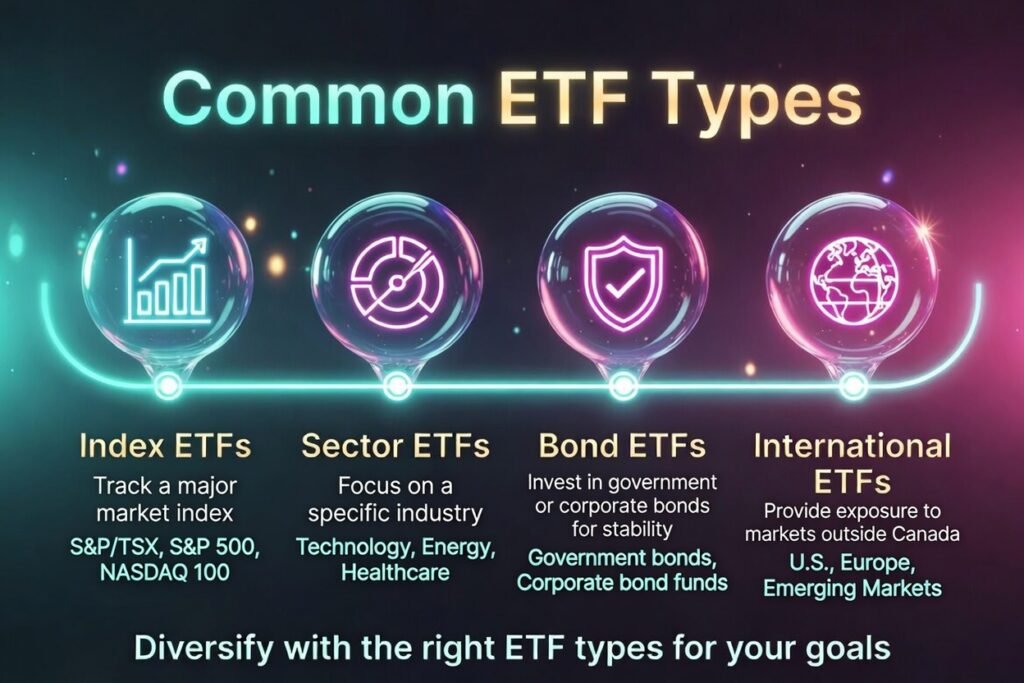
Not all ETFs are the same. Different ETFs focus on different parts of the market. Here are a few common types beginner investors should know.
| ETF Type | Description | Examples |
|---|---|---|
| Index ETFs | Track a major market index | S&P/TSX, S&P 500, NASDAQ 100 |
| Sector ETFs | Focus on a specific industry | Technology, Energy, Healthcare |
| Bond ETFs | Invest in government or corporate bonds for stability | Government bonds, Corporate bond funds |
| International ETFs | Provide exposure to markets outside Canada | U.S., Europe, Emerging Markets |
Benefits of ETFs for Beginners
Over the past decade, ETFs have become extremely popular. There are a few key reasons why.
| Benefit | Explanation |
|---|---|
| Diversification | Spread your investment across multiple companies |
| Lower Fees | Typically cheaper than mutual funds |
| Simplicity | No need to research dozens of individual stocks |
| Accessibility | Can be purchased on Canadian brokerage platforms |
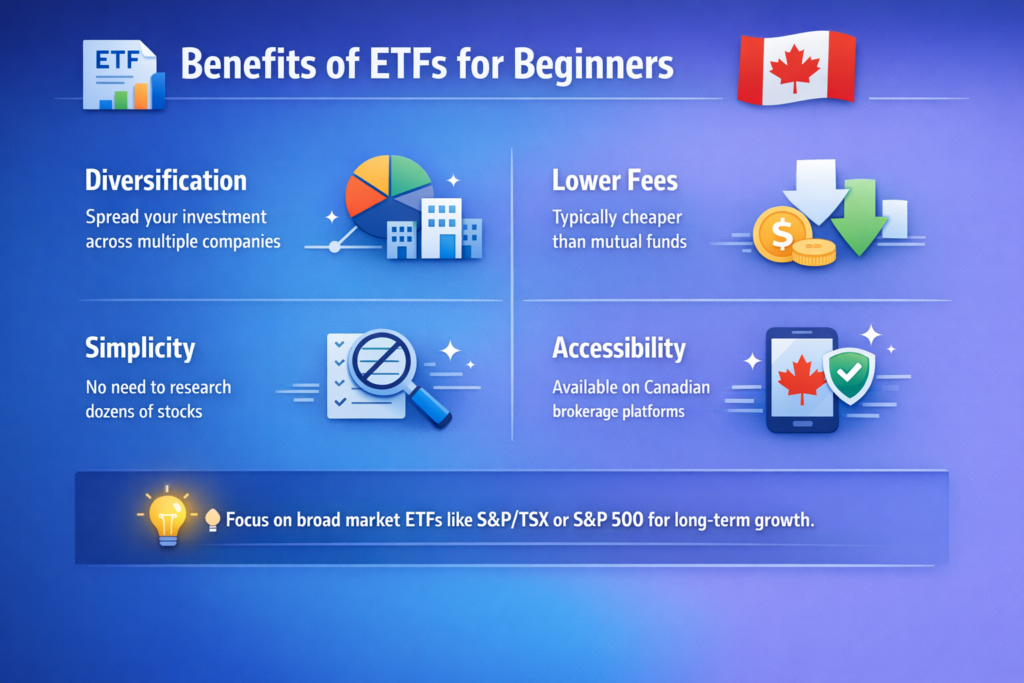
💡 Tip: Focus on broad market ETFs like S&P/TSX or S&P 500 for long-term growth.
Starting with ETFs is a straightforward approach for new investors. Utilizing ETFs can be an effective strategy to build a balanced portfolio.
Common Mistakes
Even though ETFs are beginner-friendly, new investors can still make a few common mistakes.
| Mistake | Explanation |
|---|---|
| Overtrading | Frequent buying and selling can reduce returns |
| Chasing Performance | Buying funds based only on recent short-term gains |
| Not Diversifying | Investing in only one sector ETF |
| Ignoring Fees | Even small management fees can compound over time |
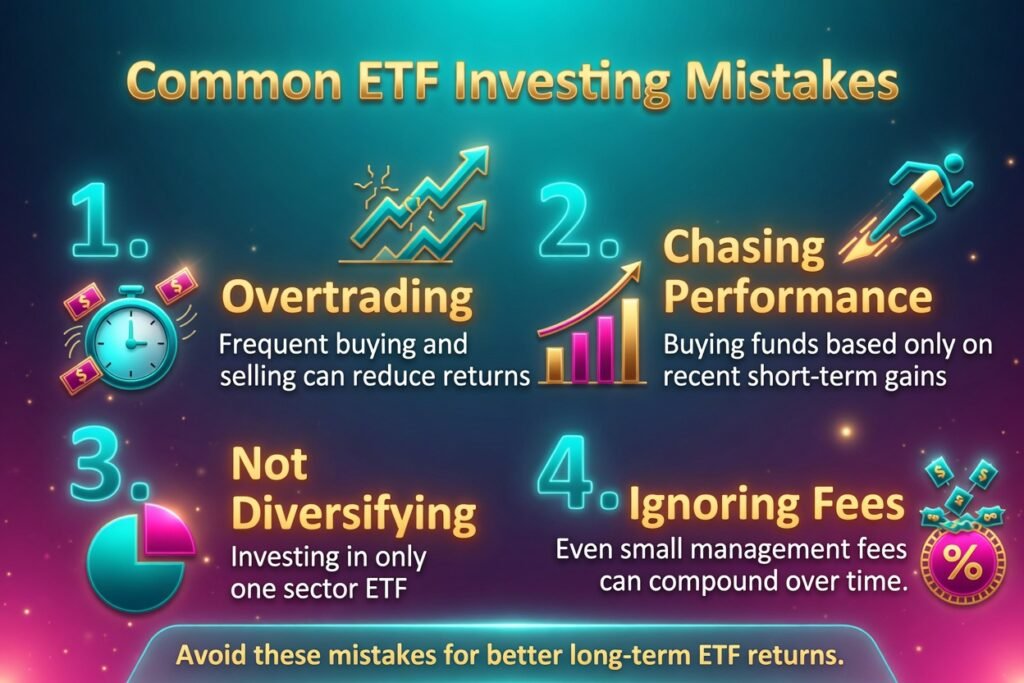
💡 Tip: Long-term investors usually stick with broad-market ETFs rather than constantly switching funds.
How to Start Investing in ETFs
Starting with ETFs is easier than many people think.
Steps to begin:
- Open a brokerage account
- Deposit funds
- Choose beginner-friendly ETFs
- Invest consistently over time
Investors can open a brokerage account and start building an ETF portfolio through most financial institutions or online brokerages. Most platforms allow you to start investing with small amounts while building diversified portfolios.
💡 Tip: Learn ETF investing for beginners with this simple guide. Discover how ETFs work and start investing step by step today.
Final Thoughts
ETFs have become one of the most beginner-friendly ways to start investing. Starting with a few diversified ETFs can be a strong foundation for long-term wealth.
They provide:
- Diversification
- Lower fees
- Access to entire markets
- Simple portfolio management
Remember the basics:
- Invest consistently
- Stay diversified
- Focus on long-term growth
- Avoid emotional decisions
Explore our full library of investing guides, tools, and beginner resources at ReadySetInvesting Guides & Resources to continue building your financial knowledge.